
A legal question rarely stands alone
A useful answer to a legal question depends on the rules and the facts of the matter. A contract, earlier correspondence or an internal policy may change what needs to be researched. Working in Juris OS therefore includes choosing the context your research should draw on.
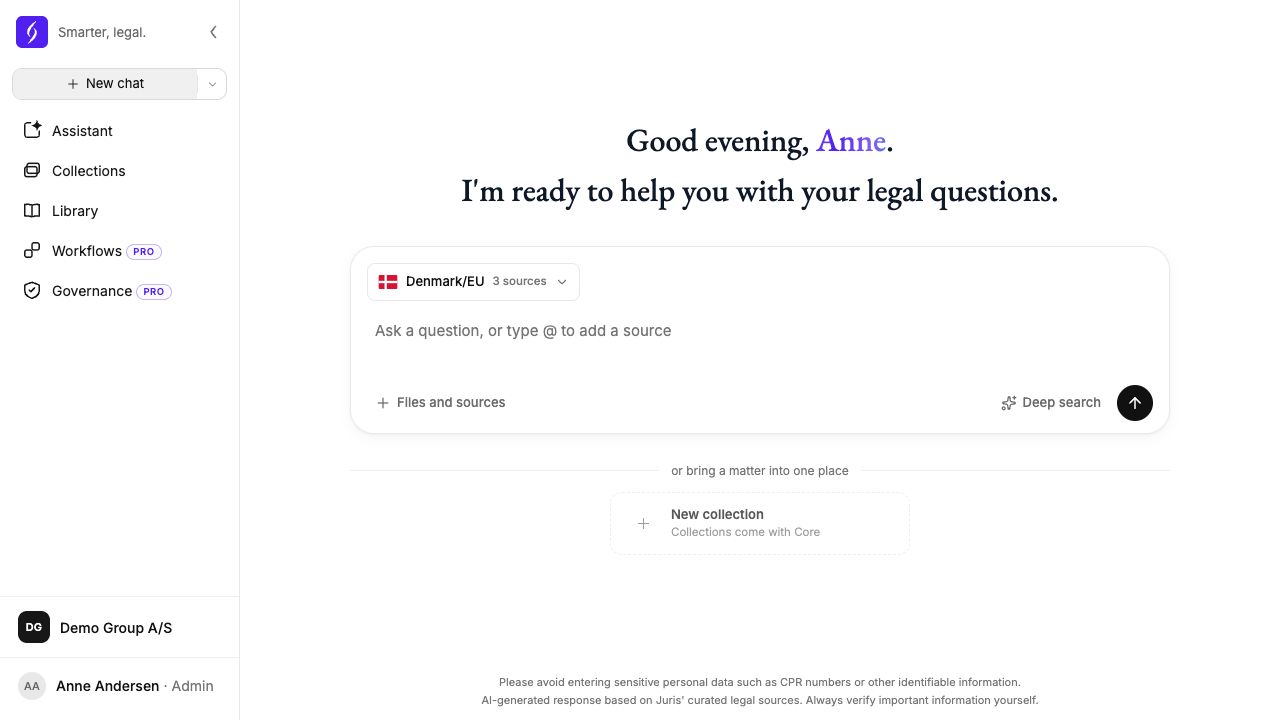
Start with the Assistant
The Assistant is the entry point for legal research. Ask a question and choose the sources and documents to use. Juris searches the material and helps draft an answer with citations.
Check the citations before relying on an answer. Open the relevant passages and assess whether they support it and apply to the matter. Turn on Deep search when a question calls for a broader search.
Give the matter a workspace
When the work involves several documents and conversations, bring them into a Collection. It might hold a company's supplier agreement or the material for a public authority's case. The documents remain available as work on the matter continues.
Matter context records goals, conclusions and open questions. You can edit it so the next conversation starts with what matters. A timeline can help identify events and deadlines in the material. Review the dates it finds, as you would other information extracted by AI.
Keep reference knowledge distinct from matter facts
A Library serves a different purpose from a Collection. It holds knowledge intended for reuse: policies, templates and selected external sources. A document from a particular matter and a shared policy may both be relevant, but they play different roles in an assessment.
Within a Library, you choose who can access the material. We can walk through the features and confirm availability for your organisation in a demo.
Context does not replace judgement
More context lets you ask more precise questions. It does not guarantee a correct or complete answer. Your team still needs to check the material, sources and legal assessment.
You do not need to build a Workflow to work this way. The Assistant and Collections support day-to-day matter work. Workflows are useful when you want a defined procedure with steps and review points set in advance.